All nationalities have their particular characteristic that a part of being interesting can help you to integrate better in the country. In this article we show you the most typical habits of Spanish people.
The punctuality of the British, the German efficiency, the good manners of a French... It is clear that each country has its own topics associated with it. They are such ingrained images that they arise automatically when we think of it. And Spain is not an exception.
Days of sun and beach, bullfights, flamenco and faralaes dresses flood the popular imagination of many tourists. Next, we review the most common stereotypes that foreigners have of the Spanish, as well as the customs that most surprise them when they finally discover the country. The balance should not be bad when some of them decide to buy a house in Spain and stay to live there.
1. The siesta, an institution
This Spanish invention is one of the habits that most disconcerts foreigners (although some adopt it when they return to their country). And it is that a good nap helps to regain strength for the afternoon and reduces the stress of everyday life. However, those two-hour naps are a true myth; in fact, only 1 or 2 out of 10 Spaniards practice it daily.
2. Strange schedule
In much of Europe it is inconceivable to eat at 3pm and start dinner at 9pm. It is also not unusual for many businesses to close from 2:00 p.m. to 4:00 p.m. But the rhythm of life in Spain is different. The milder climate allows people to spend more time on the streets, which is why foreigners have the impression that the Spanish do everything late.
3. Two kisses to greet
The Spanish custom of greeting everyone with a couple of kisses greatly surprises British and Nordic people, not used to such effusiveness. Channeling emotions through physical contact is so normal for him that a Spaniard does not think that touching the arm or shoulder of his interlocutor can bother him.
4. Passion for food: shall we go for tapas?
In Spain you eat wonderfully and the variety of dishes is immense, although many tourists only have paella, sangria or tortilla de patata in mind. For a Spaniard, food is a party that must be shared with friends, which is why tapas are so popular, that Hispanic invention that allows you to try small gastronomic delicacies at any time accompanied by a good wine or beer. So it's no wonder tapas bars do so well anywhere in the world.
5. Loud speaking
Spaniards are very effusive and tend to speak loudly anywhere, in contrast to countries as close as Germany or France. Sometimes a lively conversation can seem like a shouting match to a more restrained foreigner.
6. Olive oil for everything
In many countries it is customary to cook with sunflower oil or butter, something that does not happen in Spain. Those who visit the country for the first time are quite struck by the use of olive oil in a large number of dishes, even the fact of having it alone for breakfast on bread or simple toast.
7. Spain is a party
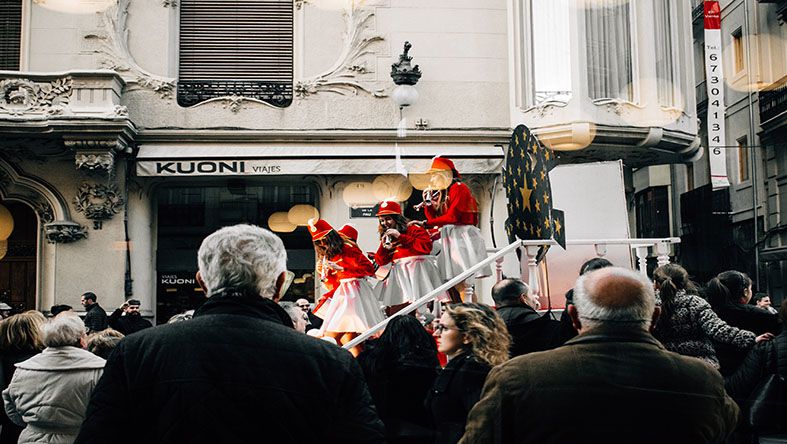
Visitors from other countries are amazed by the large number of traditional festivities that are organized in Spain. These popular festivals are the most direct manifestation of the cheerful and fun character of a Spaniard. Annual events such as the Sanfermines, the Fallas or the April Fair are already famous throughout the world, which does not mean that the country lives in a continuous party…
8. Young people become independent very late
In Spain it is not uncommon for Children continue to live with their parents until they are 30 years old. This is even more striking if we compare it with countries such as Sweden, Norway or Denmark, where less than 5% of young people between 25 and 35 years of age have not yet become emancipated.
9. The kings of improvisation
For a good number of foreigners, Spaniards have an excessive facility for being unpunctual, doing things late and in an apparently chaotic way, which leads them to have to improvise on the fly. The latter, however, speak of spontaneity and naturalness.
10. Suspense in languages
Speaking a second language seems to be the unfinished business of the Spanish, despite the large number of tourists who visit the country every year. Although this is changing by lowering the age at which children start studying English at school, the difference is still great compared to other European states.